
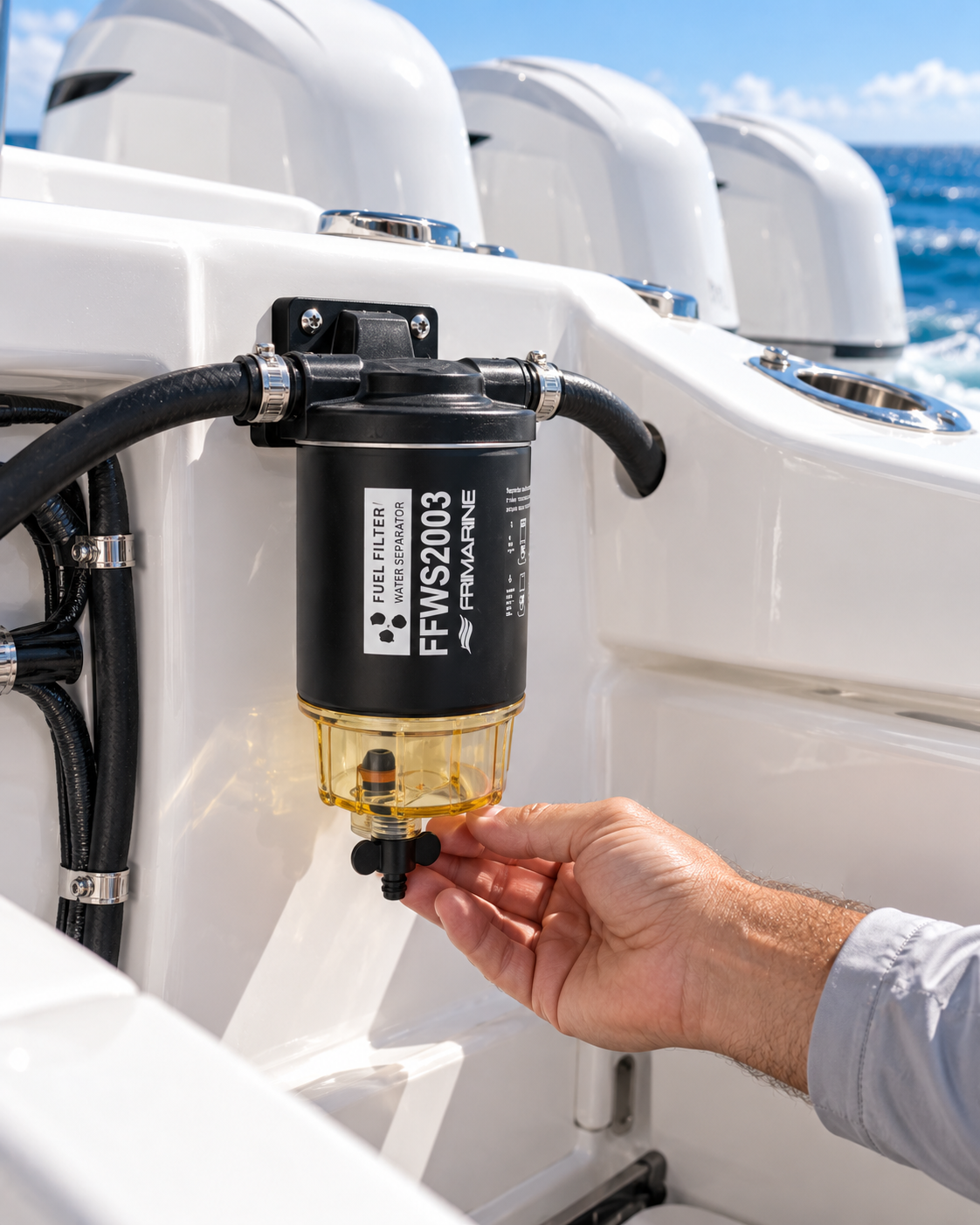
Short answer: for most gasoline outboards, choose a 10 micron fuel water separator. Outboard makers build their own separators around that rating: Yamaha's water-separating filters and Quicksilver's separators for outboards are 10 micron. A 30 micron filter lets through particles three times larger, so it is better suited as a first-stage (primary) filter on diesel inboards that already have a finer filter on the engine.
What does "micron" mean on a fuel filter?
A micron is one thousandth of a millimeter. The rating tells you the size of particle the filter media is designed to capture. A 10 micron filter stops smaller dirt than a 30 micron filter, but it also loads up faster if your fuel is very dirty. That trade-off is the whole decision.
10 vs 30 micron at a glance
| 10 micron | 30 micron | |
|---|---|---|
| Typical use | Gasoline outboards and sterndrives | Primary filter on diesel inboards |
| What it catches | Fine dirt, rust and debris plus free water | Larger debris and free water |
| Change interval | Shorter if fuel is dirty | Longer, but needs a finer filter after it |
| Protects | Injectors and fuel pumps directly | The engine's own secondary filter |
Why outboards use 10 micron
Modern fuel-injected outboards have tight-tolerance injectors and high-pressure pumps. The fuel water separator on the transom or under the console is often the main line of defense before the engine's small onboard filter. A 10 micron element catches the fine particles that cause injector problems while still separating free water before it reaches the engine.
When does 30 micron make sense?
On diesel inboards, owners commonly run a 30 micron primary filter first and let the engine-mounted secondary filter handle the fine filtration. The coarser primary filter lasts longer between changes and keeps the fine filter from clogging. If you have only one filter between the tank and a gasoline outboard, 30 micron is usually too coarse.
Signs your filter is the wrong rating or overdue
- Engine bogs or loses power at higher RPM: filter may be clogged.
- Water visible in the clear collecting bowl: drain it and check your fuel source and tank vent.
- Rough idle or injector issues after a filter change: a coarse filter may be letting debris through.
Ethanol (E10) fuel and your separator
E10 gasoline can absorb some water and, past a certain point, "phase separate" into a water-ethanol layer at the bottom of the tank. A water separator helps catch free water, but it is not a fix for phase-separated fuel. Keep tanks topped up during storage, use a stabilizer and check the bowl regularly, especially in humid climates like Florida.
Which Frimarine filter do I need?
- FFWS2003: 10 micron spin-on, 11/16" thread, for outboards with 3/8" fuel lines.
- FFWS2007: 10 micron spin-on, 1" thread.
- FFWS1003 complete kit (3/8", outboard) and FFWS1007 complete kit (3/4", inboard): filter, water collecting bowl and bracket in one box.
Frimarine filters remove 99% of free water (per SAE test procedures) and are rated 98% efficient at 10 microns. See our fuel filter buying guide to match the right bracket and bowl.
FAQ
Can I use a 10 micron filter on a diesel?
Yes, but on diesels a 10 micron filter is usually placed after a coarser primary, or as the secondary stage. Follow your engine manufacturer's recommendation.
Is a 2 micron filter better for an outboard?
Not necessarily. Finer filters clog faster, and most outboard manufacturers specify 10 micron for water-separating filters. Always check your engine manual.
How often should I change it?
Follow your engine's service schedule. Many owners change it at least once a season and drain the bowl whenever water appears.